
In modern metal casting manufacturing, few processes offer the same combination of precision, design flexibility, and material versatility as investment casting. Also known as lost wax casting, this manufacturing method is widely used to produce complex metal components with excellent dimensional accuracy and smooth surface finishes.
From aerospace turbine blades to marine hardware and medical devices, precision investment castings has become an essential process for industries that demand high-performance metal parts with minimal machining requirements.
In this guide, we explain what investment casting is, how the investment casting process works, the benefits of precision investment castings, and the industries that rely on this advanced manufacturing technology.
What Is Investment Casting?
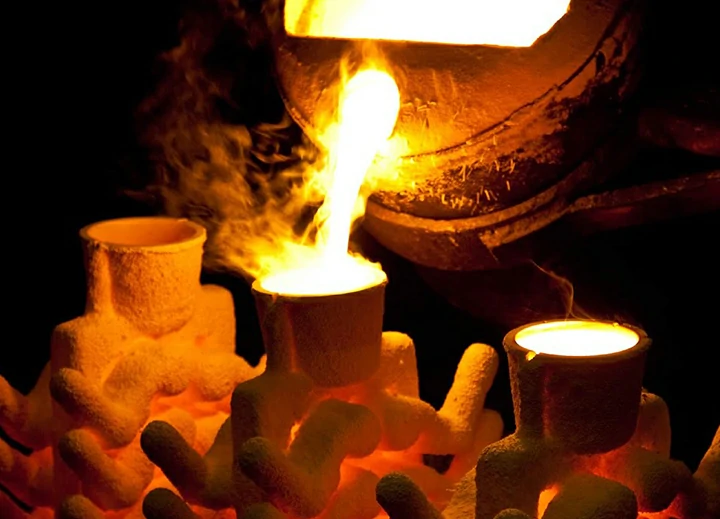
Investment casting is a precision manufacturing process in which molten metal is poured into a ceramic mold created around a wax pattern. Once the ceramic shell hardens, the wax is melted and removed, leaving a highly accurate cavity for the final metal component.
The term “investment” refers to the process of surrounding the wax pattern with refractory ceramic materials to form the mold.
Because the mold is built directly around an exact wax replica, investment casting can produce highly detailed parts with:
- Tight dimensional tolerances
- Smooth surface finishes
- Complex geometries
- Thin-wall structures
- Consistent repeatability
Due to these advantages, investment casting is often preferred over traditional metal casting manufacturing methods for intricate or high-performance applications.
How Does Investment Casting Work?
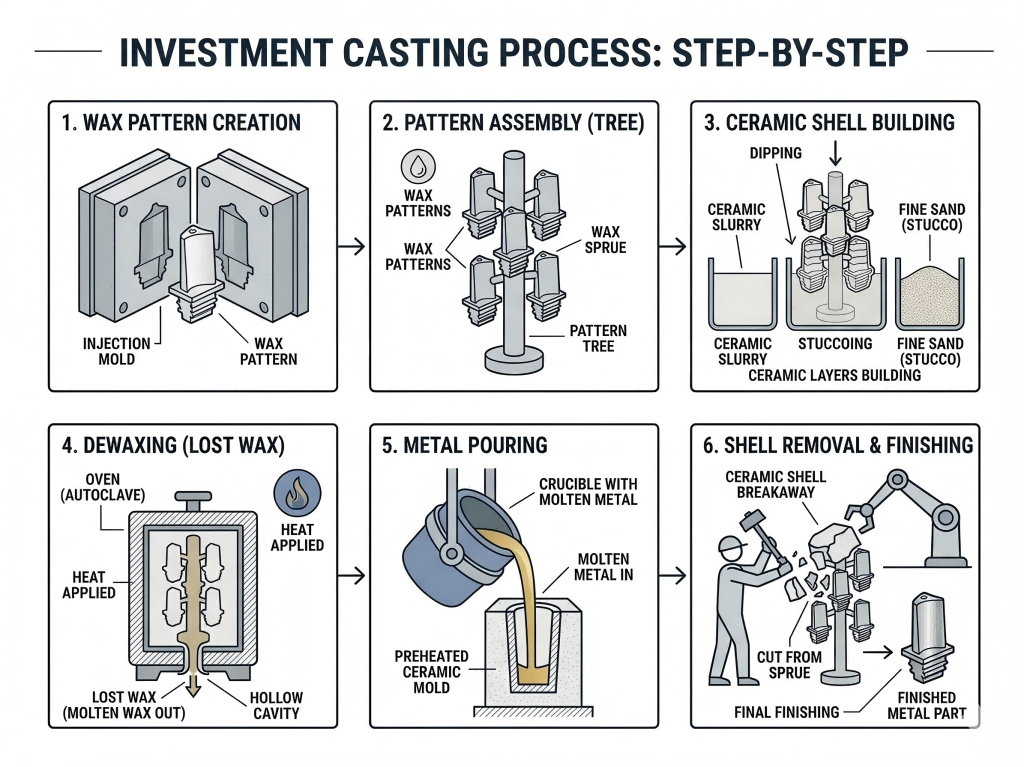
The investment casting process is a multi-step journey designed to ensure every detail of the original design is captured in the final metal part.
1. Wax Pattern Creation
The process begins with producing a wax replica of the final component using precision injection tooling. These wax patterns accurately reproduce the shape, dimensions, and fine details of the finished metal part. Because the quality of the final casting depends heavily on the wax pattern, precision at this stage is critical.
2. Pattern Assembly
MMultiple wax patterns are attached to a central wax sprue to form a “tree,” allowing multiple parts to be cast simultaneously, to improve production efficiency and reducing manufacturing costs.
3. Ceramic Shell Building
The wax assembly is repeatedly dipped into ceramic slurry and coated with fine refractory sand. Several ceramic layers are gradually built up to create a strong, heat-resistant shell capable of withstanding molten metal temperatures.
4. Dewaxing
After the ceramic shell fully cures, the assembly is heated in an autoclave or furnace to melt and remove the wax. This step creates the hollow mold cavity used for casting and is the reason investment casting is also known as lost wax casting.
5. Metal Pouring
Molten metal is poured into the preheated ceramic mold under carefully controlled conditions.
Common materials used in investment casting include:
- Stainless steel
- Carbon steel
- Alloy steel
- Aluminum alloys
- Brass
- Bronze
- Heat-resistant superalloys
6. Cooling and Shell Removal
Once the molten metal solidifies, the ceramic shell is broken away to reveal the cast components. The parts are then separated from the casting tree and cleaned.
7. Finishing Operations
Depending on the application, additional finishing processes may include:
- CNC machining
- Grinding
- Polishing
- Heat treatment
- Surface coating
- Passivation
These secondary operations help achieve final dimensional and surface requirements.
Common Applications of Investment Casting
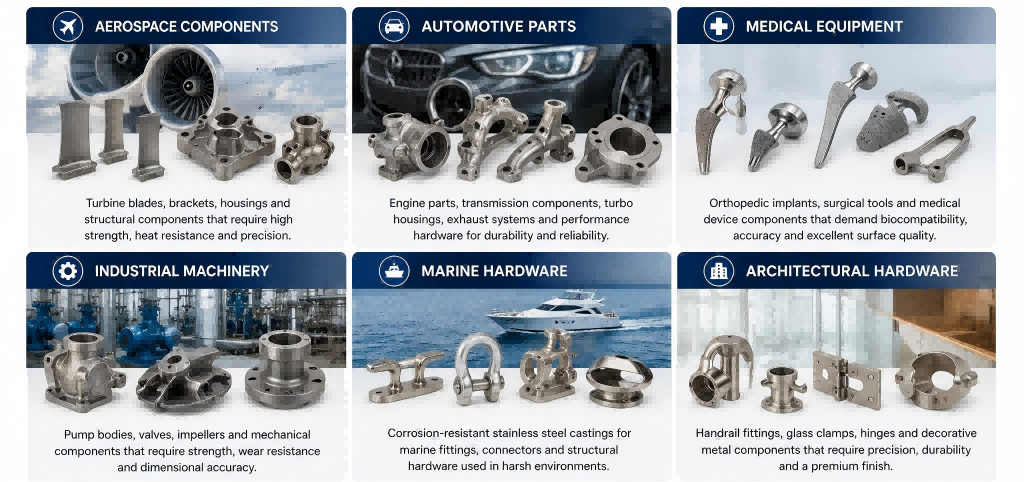
Investment casting is ideal for manufacturing metal parts that require complex geometries, thin walls, and tight tolerances with minimal machining. Common applications include:
- Aerospace Components: Aerospace manufacturers use precision investment castings for turbine blades, brackets, housings, and engine components that require high accuracy and heat resistance.
- Automotive Parts: Investment casting is commonly used for transmission parts, exhaust components, turbocharger elements, and performance hardware.
- Medical Equipment: Orthopedic implants, surgical tools, and medical device components benefit from the precision and surface quality provided by investment casting.
- Industrial Machinery: Pump bodies, valves, impellers, and mechanical components often rely on investment casting for durability and dimensional consistency.
- Marine Hardware: Corrosion-resistant stainless steel castings are widely used in marine environments for fittings, connectors, and structural hardware.
- Architectural Hardware: Handrail fittings, glass clamps, hinges, and decorative metal products are frequently manufactured using precision investment castings.
Benefits of Precision Investment Casting
The growing demand for precision investment castings comes from its ability to combine manufacturing efficiency with exceptional product quality.
High Dimensional Accuracy
Investment casting can achieve tighter tolerances than many traditional casting methods, reducing the need for extensive machining.
This helps manufacturers improve assembly consistency and reduce production costs.
Excellent Surface Finish
The ceramic shell process produces smooth surfaces that often require minimal post-processing.
This reduces finishing time while improving the visual appearance of the final product.
Complex Design Capability
Investment casting can produce intricate shapes, internal passages, thin sections, and detailed geometries that may be difficult or impossible to achieve with other manufacturing methods.
Wide Material Selection
The process supports a broad range of ferrous and non-ferrous alloys, including stainless steel, carbon steel, aluminum, bronze, and specialty superalloys.
This flexibility allows manufacturers to meet different strength, corrosion resistance, and temperature requirements.
Reduced Material Waste
Because investment casting is a near-net-shape manufacturing process, material waste is minimized compared to heavy machining methods.
This improves raw material utilization and overall production efficiency.
Cost Efficiency for Complex Parts
Although tooling costs may initially be higher, investment casting often reduces total manufacturing costs for complex components by minimizing machining, welding, and assembly operations.
Investment Casting vs Other Casting Methods
Understanding how investment casting compares with other manufacturing processes helps buyers select the right production method for their application.
| Casting Method | Surface Finish | Dimensional Accuracy | Complex Shapes | Typical Volume |
| Investment Casting | Excellent | High | Excellent | Low to Medium |
| Sand Casting | Rough | Moderate | Moderate | Low to High |
| Die Casting | Good | High | Good | High |
| Forging | Moderate | High | Limited | Medium to High |
Investment casting is particularly suitable when precision, surface quality, and geometric complexity are more important than extremely high-volume production.
Materials Commonly Used in Investment Casting
- Stainless Steel: Provides excellent corrosion resistance and mechanical strength for industrial, marine, and architectural applications.
- Carbon Steel: Offers strong mechanical performance and cost efficiency for general engineering components.
- Alloy Steel: Used for wear resistance, impact strength, and high-performance industrial applications.
- Aluminum Alloys: Lightweight and corrosion resistant, making them suitable for automotive and aerospace industries.
- Brass and Bronze: Frequently selected for decorative hardware, marine fittings, and corrosion-resistant applications.
Why Manufacturers Choose Investment Casting
Manufacturers across multiple industries choose investment casting because it offers:
- High precision
- Excellent repeatability
- Superior surface quality
- Complex part capability
- Reduced machining requirements
- Flexible alloy selection
- Efficient production for detailed components
These advantages make investment casting one of the most reliable solutions for producing high-quality custom metal parts.
Future Trends in Investment Casting
Modern investment casting continues evolving through advanced manufacturing technologies, including:
- Automated shell-building systems
- Robotic finishing processes
- Improved simulation software
- Advanced alloy development
- Sustainable manufacturing practices
These innovations help manufacturers improve quality, reduce defects, and increase production efficiency.
Conclusion
Investment casting remains one of the most effective methods for producing precision metal components with complex geometries and excellent surface finishes.
By combining design flexibility, material versatility, and high dimensional accuracy, the investment casting process supports a wide range of industries including aerospace, automotive, medical, marine, industrial machinery, and architectural hardware.
For companies seeking reliable and efficient metal casting manufacturing solutions, precision investment casting continues to deliver long-term value through consistent quality, reduced machining, and superior performance.