
Selecting the right manufacturing process is one of the most important decisions when developing metal components. The casting method directly affects product quality, dimensional accuracy, production efficiency, material options, and overall cost.
Among modern casting technologies, investment casting and die casting are two of the most widely used methods. Both processes can produce complex metal parts, but they serve different manufacturing needs and industries.
This guide provides a detailed comparison of investment casting vs die casting, including process differences, material compatibility, production costs, design flexibility, and typical applications. Understanding these factors will help engineers, designers, and procurement professionals choose the most suitable solution for their projects.
What Is Investment Casting?
Investment casting, often called lost-wax casting, is a precision casting vs die casting alternative used to produce highly detailed components. The process uses a sacrificial wax pattern coated with liquid ceramic to build a rigid shell. Once the ceramic hardens, the wax is melted out, leaving a highly detailed cavity where molten metal is poured. After solidification, the ceramic shell is broken away to reveal the finished part.
The process is known for producing:
- Complex geometries
- Tight dimensional tolerances
- Excellent surface finishes
- Thin-wall structures
- Near-net-shape components
Investment casting is commonly used for stainless steel, carbon steel, alloy steel, brass, bronze, and other specialty alloys.
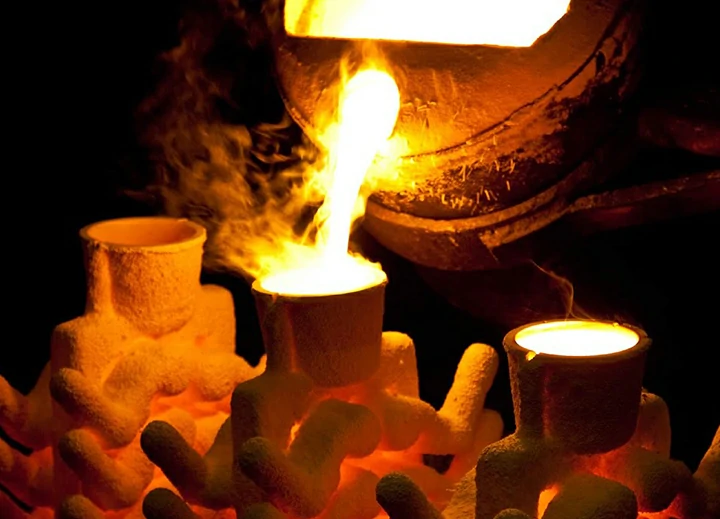
Typical Investment Casting Applications
- Industrial valves
- Pump components
- Marine hardware
- Aerospace parts
- Medical instruments
- Architectural hardware
- Stainless steel fasteners
What Is Die Casting?
The die casting process relies on reusable, permanent steel molds called dies. Instead of relying on gravity, high-pressure die casting machines inject molten non-ferrous metals (such as aluminum, zinc, or magnesium) into the steel die under immense hydraulic pressure. Once the metal solidifies, the die opens, the part is ejected, and the rapid cycle repeats. This process allows manufacturers to produce large quantities of identical parts with excellent repeatability.
Die casting is most commonly used with:
- Aluminum alloys
- Zinc alloys
- Magnesium alloys
Typical Die Casting Applications
- Automotive housings
- Consumer electronics
- Electrical enclosures
- Appliance components
- Lighting fixtures
- Telecommunications equipment
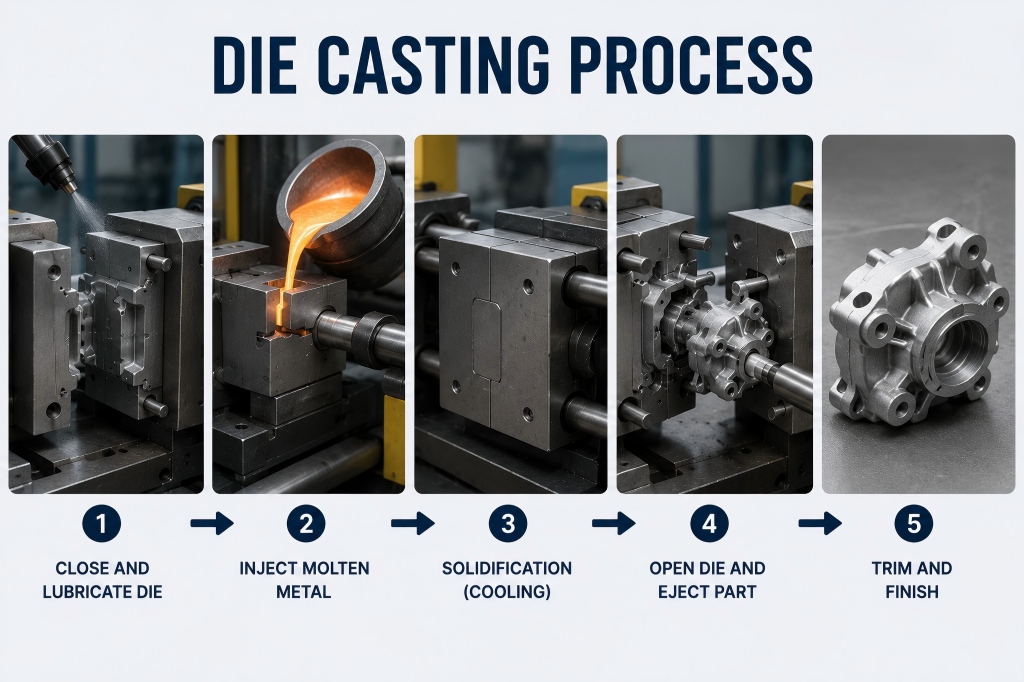
Investment Casting vs Die Casting: Key Differences
Understanding the major differences between these two processes is essential when conducting a casting manufacturing comparison.
1. Material Compatibility
Material selection highlights a massive technical divide between the two processes.
- Investment Casting Alloys:Supports an exceptionally wide range of metals, including stainless steel, carbon steel, alloy steel, brass, bronze, and nickel alloys. This makes investment casting the preferred solution for high-strength and corrosion-resistant applications.
- Die Casting Alloys: Restricted primarily to lower-melting-point non-ferrous metals like aluminum, zinc, magnesium, and certain copper alloys.
For stainless steel and specialty alloys, investment casting offers far greater material options.
Winner: Investment Casting
2. Precision and Surface Finish
- Investment Casting: One of the major lost wax casting advantages is exceptional dimensional accuracy and surface quality. Benefits include tight tolerances, smooth surfaces, minimal machining, and fine detail reproduction.
- Die Casting: Die casting also produces accurate parts and excellent repeatability, especially in high-volume manufacturing. However, mold wear over time can gradually affect dimensional consistency.
Winner: Tie
Both processes provide excellent precision, though investment casting generally offers greater flexibility for highly detailed geometries.
3. Design Complexity
A critical factor in precision casting vs die casting evaluations is design freedom.
- Investment Casting: Investment casting uses a ceramic shell that is broken away after casting. This allows manufacturers to produce complex internal channels, deep recesses, intricate details, thin-wall structures, and undercut features.
- Die Casting: Because die-cast parts must be mechanically ejected from a steel mold, designs require draft angles, simpler internal geometries, and limited undercuts.
Winner: Investment Casting
For highly complex parts, investment casting provides significantly greater design flexibility.
4. Production Volume
- Investment Casting: investment casting is ideal for low-to-medium production volumes, specialized components, custom-engineered parts.
- Die Casting: the die casting process excels in high-volume production, automated manufacturing, rapid cycle times, and consistent repeatability.
Winner: Die Casting
For mass production, die casting is generally the more efficient solution.
5. Tooling Investment
- Investment Casting: Investment casting requires wax injection tooling, ceramic shell production, moderate setup costs. Tooling investment is typically lower than die casting.
- Die Casting: Die casting requires precision-machined steel molds capable of withstanding high injection pressures. These molds can be expensive to manufacture but are highly durable for large production runs.
Winner: Investment Casting
For lower production quantities, investment casting often provides a more economical tooling solution.
Investment Casting vs Die Casting Cost Comparison
One of the most common buyer questions involves investment casting vs die casting cost comparison.
Investment Casting Costs
Investment casting generally offers:
- Lower tooling investment
- Greater material flexibility
- Reduced machining for complex parts
However, production cycles are slower than die casting.
Die Casting Costs
Die casting typically involves:
- Higher initial tooling costs
- Faster production cycles
- Lower unit costs at high volumes
The process becomes increasingly cost-effective as production quantities rise.
General Rule
- Low-to-medium volume production → Investment Casting
- High-volume production → Die Casting
When to Use Investment Casting Instead of Die Casting
Choosing the correct method generally comes down to three major deciding factors:
1. You Need Ferrous Alloys (Stainless Steel)
Die casting molds are made of steel. Because ferrous metals like stainless steel have exceptionally high melting points, injecting them into a steel mold would destroy the tooling. If your part requires the corrosion resistance of stainless steel, investment casting is mandatory.
2. Your Production Volumes Are Low to Moderate
If your project only requires a few hundred or a few thousand components, the massive upfront tooling expense of die casting cannot be easily amortized. Investment casting offers a much faster path to profitability.
3. The Part Has Complex Internal Geometries
When your design calls for deep recesses, thin-walled structures, or intricate internal channels, the sacrificial ceramic shell of investment casting makes it the superior choice.
Summary Guide
- Choose Investment Casting for: Stainless steel parts, complex geometries, premium surface finishes, and low-to-moderate production volumes (e.g., valve components, marine fittings, and industrial fasteners).
- Choose Die Casting for: Mass production of aluminum or zinc components where high repeatability, fast cycle times, and minimizing unit cost are the primary goals (e.g., automotive housings and electrical enclosures).
Conclusion
The debate between investment casting vs die casting does not have a one-size-fits-all answer. Both manufacturing methods offer unique advantages and are suited to different applications.
Investment casting provides exceptional design flexibility, material versatility, and precision for complex metal components, especially those made from stainless steel and specialty alloys. Die casting delivers outstanding efficiency, repeatability, and low unit costs for large-scale production of aluminum and zinc parts.
By understanding the difference between investment casting and die casting, manufacturers can make informed decisions that balance quality, performance, production efficiency, and cost.
Ready to Discuss Your Casting Project?
Whether you need precision stainless steel investment castings or custom-engineered metal components, Highco Metal has the expertise and manufacturing capabilities to support your project.