
In today’s manufacturing industry, choosing the right material is just as important as selecting the right production process. When applications demand exceptional corrosion resistance, mechanical strength, dimensional accuracy, and long-term durability, Stainless Steel Investment Casting remains the preferred manufacturing solution.
By combining the precision of the lost wax process with the outstanding properties of stainless steel, manufacturers can produce highly complex metal components with excellent surface quality, minimal machining, and consistent performance. From marine hardware and industrial valves to food processing equipment and architectural fittings, stainless steel investment castings continue to set the benchmark for quality and reliability.
This guide explains why stainless steel is the industry’s preferred investment casting material, compares common stainless steel grades, highlights the benefits of stainless steel lost wax casting, and explores the industrial applications for cast stainless steel.
What Is Stainless Steel Investment Casting?
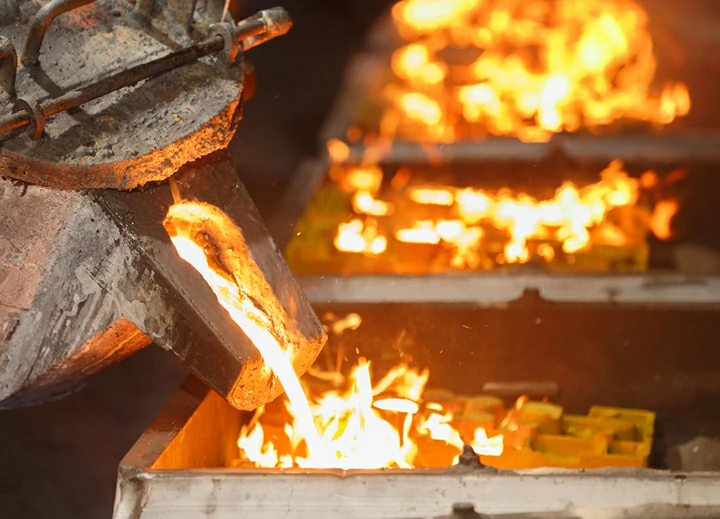
Stainless Steel Investment Casting is a precision manufacturing process in which a wax pattern is coated with ceramic material to create a mold. After the wax is melted away, molten stainless steel is poured into the cavity to produce highly accurate metal components.
Compared with conventional casting methods, investment casting offers:
- Excellent dimensional accuracy
- Complex geometries and thin-wall sections
- Smooth surface finishes
- Minimal machining requirements
- High material utilization
Because the ceramic mold faithfully reproduces every detail of the wax pattern, the process is ideal for manufacturing intricate components that would be difficult or expensive to machine.
Why Stainless Steel Is the Preferred Investment Cast Alloy
Among all investment cast alloys, stainless steel offers one of the best combinations of strength, durability, corrosion resistance, and manufacturing flexibility.
Outstanding Corrosion Resistance
Corrosion resistance is one of the primary reasons manufacturers select stainless steel. The chromium content naturally forms a passive oxide layer that protects the surface against:
- Rust
- Moisture
- Saltwater
- Industrial chemicals
- Acidic environments
- Atmospheric corrosion
This makes stainless steel particularly suitable for outdoor, marine, food-grade, and chemical processing applications where long service life is essential.
Excellent Mechanical Strength
Stainless steel provides an outstanding balance of strength and toughness. Compared with many alternative casting materials, it offers:
- High tensile strength
- Excellent impact resistance
- Superior fatigue performance
- Good wear resistance
- Reliable structural integrity
These mechanical properties allow cast components to perform reliably under continuous mechanical loading and harsh operating conditions.
Heat and Oxidation Resistance
Many stainless steel grades maintain their strength and oxidation resistance at elevated temperatures. Typical applications include:
- Heat exchangers
- Exhaust systems
- Petrochemical equipment
- Industrial furnaces
- Power generation equipment
Benefits of Stainless Steel Lost Wax Casting
The benefits of stainless steel lost wax casting extend well beyond precision manufacturing.
Exceptional Dimensional Accuracy
Investment casting produces components with tight tolerances, allowing many parts to be used with little or no secondary machining.
Benefits include:
- Improved assembly accuracy
- Better interchangeability
- Lower machining costs
- Reduced production time
Excellent Surface Finish
The ceramic shell accurately reproduces the smooth wax pattern, producing high-quality surfaces directly from the mold.
Advantages include:
- Reduced polishing
- Lower finishing costs
- Attractive appearance
- Improved sealing performance
This is particularly valuable for decorative architectural hardware and precision-engineered products.
Reduced Material Waste
Because parts are manufactured close to their final dimensions, far less material must be removed during machining.
In addition, wax, gates, runners, and excess metal can often be recycled during production, improving overall material utilization and reducing manufacturing waste.
Wide Selection of Investment Cast Alloys
Stainless steel investment casting supports numerous alloy grades for different service environments.
Common materials include:
- 304 Stainless Steel
- 304L Stainless Steel
- 316 Stainless Steel
- 316L Stainless Steel
- Duplex Stainless Steel
- Heat-resistant stainless steel alloys
Selecting the proper alloy ensures optimal mechanical performance and corrosion resistance for each application.
304 vs 316 Stainless Steel Casting
One of the most common questions from buyers is 304 vs 316 stainless steel casting. Although both grades provide excellent corrosion resistance and strength, each is designed for different service conditions.
|
Property |
304 Stainless Steel |
316 Stainless Steel |
|
Corrosion Resistance |
Excellent |
Superior |
|
Chloride Resistance |
Good |
Excellent |
|
Marine Environment |
Suitable |
Highly Recommended |
|
Chemical Resistance |
Good |
Excellent |
|
Cost |
More Economical |
Higher |
|
Typical Applications |
General Industry |
Marine & Chemical |
High-Performance Industrial Applications for Cast Stainless Steel
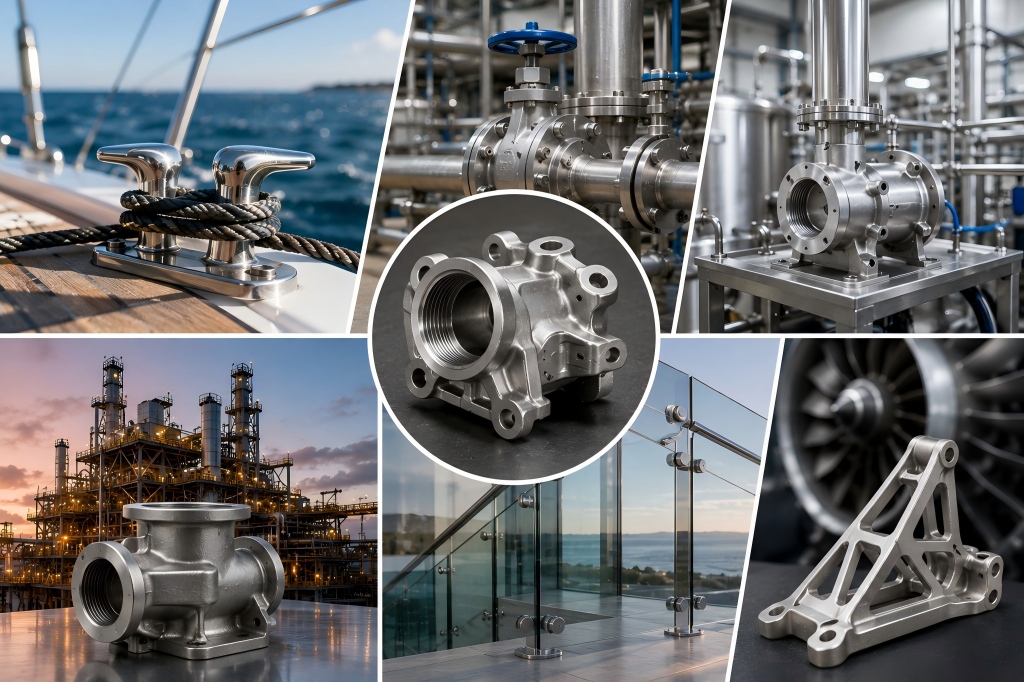
Thanks to its outstanding mechanical and corrosion-resistant properties, the industrial applications for cast stainless steel continue to expand across numerous industries.
Marine & Offshore
316 stainless steel investment castings are widely used for:
- Boat fittings
- Deck hardware
- Handrail components
- Glass railing spigots
- Mooring hardware
Excellent resistance to seawater corrosion ensures long-term reliability.
Food & Beverage Processing
The smooth, non-porous surface of stainless steel supports hygienic production environments.
Common products include:
- Pumps
- Valves
- Mixers
- Processing equipment
- Conveyor components
- Oil, Gas & Petrochemical
Investment cast stainless steel components are commonly used for:
- Valve bodies
- Flanges
- Pump impellers
- Flow control components
- Pressure equipment
These applications require outstanding strength, dimensional accuracy, and corrosion resistance.
Architecture & Construction
Modern architectural projects frequently utilize stainless steel investment castings for:
- Glass railing systems
- Handrail fittings
- Balustrade accessories
- Decorative hardware
- Structural connectors
The combination of durability and premium appearance makes stainless steel ideal for high-end construction projects.
Automotive & Aerospace
Precision cast stainless steel is also widely used for:
- Exhaust components
- Turbocharger parts
- Engine brackets
- Aerospace fittings
- High-temperature structural components
Why Choose Stainless Steel Investment Casting?
Compared with machining, fabrication, or alternative casting methods, stainless steel investment casting provides significant manufacturing advantages.
Key benefits include:
Outstanding corrosion resistance
Excellent dimensional precision
Complex geometry capability
Smooth surface finish
Lower machining requirements
Broad alloy selection
Long service life
Cost-effective production for medium-volume manufacturing
These advantages make stainless steel investment casting the preferred choice for high-performance industrial components.
Why Choose Stainless Steel Investment Casting?
Compared with machining, fabrication, or alternative casting methods, stainless steel investment casting provides significant manufacturing advantages.
Key benefits include:
- Outstanding corrosion resistance
- Excellent dimensional precision
- Complex geometry capability
- Smooth surface finish
- Lower machining requirements
- Broad alloy selection
- Long service life
- Cost-effective production for medium-volume manufacturing
These advantages make stainless steel investment casting the preferred choice for high-performance industrial components.
Conclusion
Stainless Steel Investment Casting continues to be recognized as the gold standard for manufacturing complex, high-strength, and corrosion-resistant cast parts.
Its unique combination of precision, excellent surface finish, broad alloy selection, and superior durability makes it the preferred solution for industries ranging from marine engineering and food processing to architecture, energy, and industrial equipment manufacturing.
Whether you’re comparing 304 vs 316 stainless steel casting or selecting among different investment cast alloys, choosing the right material and an experienced manufacturing partner will ensure long-lasting performance and maximum value throughout the product lifecycle.