
Selecting the right casting process is one of the most important decisions in metal component manufacturing. The casting method directly affects product quality, dimensional accuracy, surface finish, production efficiency, and overall manufacturing cost.
Among the many metal casting methods used today, investment casting and sand casting remain two of the most common solutions across industries such as aerospace, automotive, marine, industrial machinery, construction equipment, and architectural hardware.
Although both processes are designed to produce metal parts, they differ significantly in precision, tooling, production volume, material efficiency, and finishing requirements. Understanding the differences between Investment Casting vs Sand Casting helps manufacturers, engineers, and buyers choose the most cost-effective solution for their application.
This guide explains the manufacturing processes, advantages, limitations, costs, applications, and key differences between these two widely used casting methods.
What Is Investment Casting?
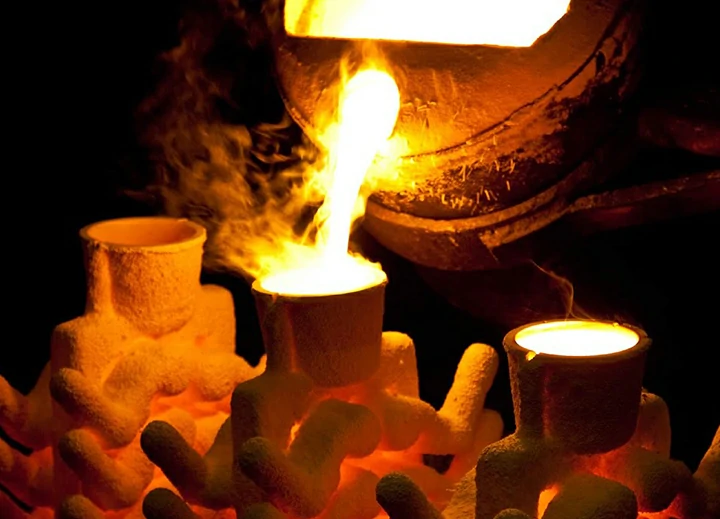
Investment casting, also known as lost wax casting, is a precision manufacturing process that produces detailed metal components using ceramic molds formed around wax patterns.
The investment casting process typically includes:
- Creating a precise wax pattern
- Building a ceramic shell around the pattern
- Melting and removing the wax
- Pouring molten metal into the ceramic mold
- Breaking away the ceramic shell after cooling
Because the ceramic mold accurately captures the details of the wax pattern, investment casting can produce components with:
- Tight dimensional tolerances
- Smooth surface finishes
- Thin-wall structures
- Intricate geometries
- Minimal machining requirements
These characteristics make investment casting ideal for complex and high-precision components.
Best Applications for Investment Casting
Investment casting is commonly used for:
- Aerospace components
- Medical devices
- Marine hardware
- Automotive performance parts
- Industrial valves and pumps
- Architectural metal fittings
What Is Sand Casting?
Sand casting is one of the oldest and most traditional metal casting manufacturing methods.
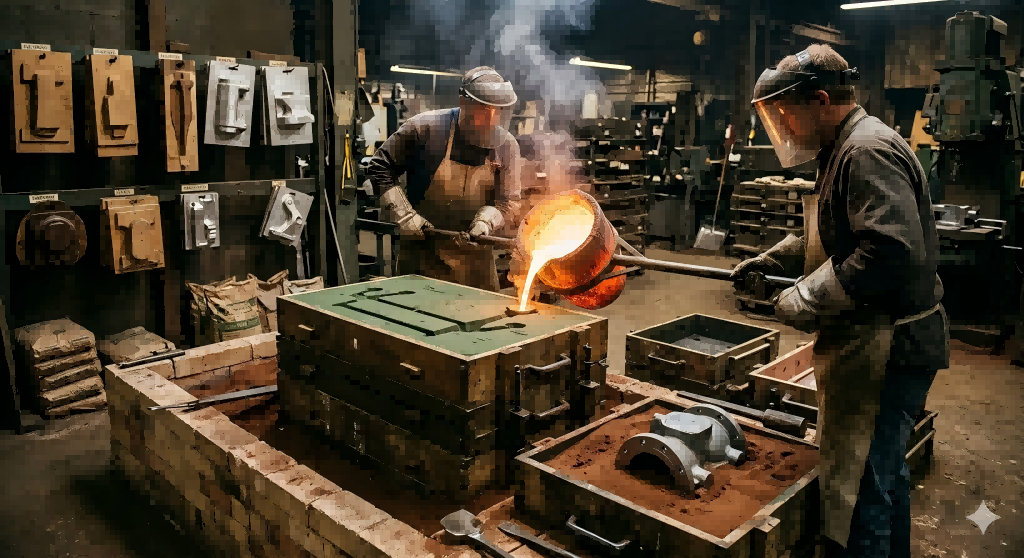
In this process, a mold cavity is created by compacting sand around a pattern. Molten metal is then poured into the sand mold and allowed to cool before the mold is broken apart to remove the finished casting.
Sand casting is widely used because it offers:
- Lower tooling costs
- Flexible mold production
- Suitability for large parts
- Simpler manufacturing setup
- Cost-effective prototype production
However, compared to investment casting, sand casting generally produces rougher surfaces and lower dimensional accuracy.
Best Applications for Sand Casting
Sand casting is commonly used for:
- Engine blocks
- Machine bases
- Heavy industrial equipment
- Agricultural machinery
- Construction equipment
- Large pump housings
Investment Casting vs Sand Casting: Key Differences
Understanding the differences between precision casting vs sand casting is essential when evaluating manufacturing quality, cost efficiency, and production capability.
1. Precision and Dimensional Accuracy
Investment Casting
One of the most important lost wax casting advantages is exceptional dimensional precision.
Investment casting can produce:
- Fine details
- Thin-wall components
- Complex internal passages
- Near-net-shape parts
The process significantly reduces secondary machining requirements.
Sand Casting
Sand casting provides moderate dimensional accuracy but is generally less precise because sand molds naturally shift and expand during casting.
Additional machining is often necessary to achieve final specifications.
Winner: Investment Casting
For high-precision components, investment casting is clearly superior.
2. Surface Finish Comparison Casting
A common concern for manufacturers involves surface finish comparison casting quality.
Investment Casting
Investment casting delivers smoother surfaces because the ceramic mold is built around a highly detailed wax pattern.
Benefits include:
- Better visual appearance
- Reduced polishing
- Lower machining costs
- Improved consistency
This makes investment casting ideal for decorative and precision-engineered components.
Sand Casting
Sand casting naturally creates rougher surfaces due to the texture of the sand mold.
Additional finishing processes may include:
- Grinding
- Sanding
- Machining
- Surface polishing
Winner: Investment Casting
Investment casting provides significantly better surface quality.
3. Part Complexity
Investment Casting
Investment casting is highly effective for producing:
- Intricate shapes
- Detailed contours
- Internal channels
- Thin-wall sections
Complex components can often be manufactured as a single piece, reducing assembly and welding requirements.
Sand Casting
Sand casting is better suited for simpler geometries and thicker wall designs.
Producing fine details consistently is more difficult.
Winner: Investment Casting
Investment casting offers greater design flexibility and precision.
4. Part Size Capability
Investment Casting
Investment casting is commonly used for small-to-medium sized components.
Although larger castings are possible, production costs increase substantially with oversized parts.
Sand Casting
Sand casting is highly suitable for large and heavy components.
Typical examples include:
- Industrial housings
- Large valves
- Engine blocks
- Machine frames
Winner: Sand Casting
Sand casting is generally more economical for large components.
5. Tooling and Production Costs
Investment Casting
Investment casting requires:
- Precision wax injection tooling
- Ceramic shell processing
- More controlled manufacturing steps
Initial tooling investment is usually higher.
However, the process can reduce overall production expenses by minimizing machining, waste, and assembly operations.
Sand Casting
Sand casting involves lower startup costs and simpler mold preparation.
This makes it ideal for:
- Prototypes
- Short production runs
- Large castings
- Budget-sensitive projects
Winner: Sand Casting
Sand casting generally offers lower initial tooling costs.
6. Material Options
Both casting methods support a wide range of metal alloys.
Common Investment Casting Materials
- Stainless steel
- Carbon steel
- Alloy steel
- Aluminum
- Brass
- Bronze
- Superalloys
Common Sand Casting Materials
- Cast iron
- Ductile iron
- Steel alloys
- Aluminum alloys
- Bronze
- Brass
Investment casting is often preferred for specialty alloys requiring high precision and excellent surface quality.
7. Production Volume
Investment Casting
Investment casting performs well for:
- Medium production volumes
- Precision industrial components
- High-value engineered parts
Sand Casting
Sand casting is commonly used for:
- Prototype production
- Small production runs
- Large industrial parts
Winner: Depends on Project Requirements
The best option depends on part complexity, production volume, and cost targets.
When to Choose Investment Casting Over Sand Casting
Manufacturers often ask: when to choose investment casting over sand casting?
Investment casting is usually the better choice when a project requires:
- Tight tolerances
- Complex geometries
- Thin-wall designs
- Smooth surface finishes
- Minimal machining
- Premium appearance
- Consistent repeatability
Typical industries include:
- Aerospace
- Medical equipment
- Marine hardware
- Precision automotive components
- Architectural metal systems
When Sand Casting Is the Better Choice
Sand casting is often preferred when projects involve:
- Large metal components
- Lower production budgets
- Simple geometries
- Short production runs
- Prototype manufacturing
Industries commonly using sand casting include heavy equipment, agriculture, construction, and industrial machinery manufacturing.
Environmental and Manufacturing Efficiency Considerations
Modern manufacturers increasingly focus on sustainability and manufacturing efficiency.
Investment Casting Advantages
- Reduced material waste
- Less machining
- Better material utilization
- Higher dimensional consistency
Sand Casting Advantages
- Reusable sand systems
- Simpler tooling
- Faster pattern modifications
Both processes can support environmentally responsible manufacturing when properly managed.
Final Thoughts
When comparing Investment Casting vs Sand Casting, there is no single solution that fits every manufacturing project.
Investment casting offers superior precision, smoother surface finishes, excellent repeatability, and greater design flexibility, making it ideal for high-performance and complex components.
Sand casting remains a cost-effective and practical solution for large parts, simple geometries, and projects requiring lower tooling investment.
By understanding the differences between these two important metal casting methods, manufacturers and buyers can select the most efficient and economical process for their specific production requirements.